




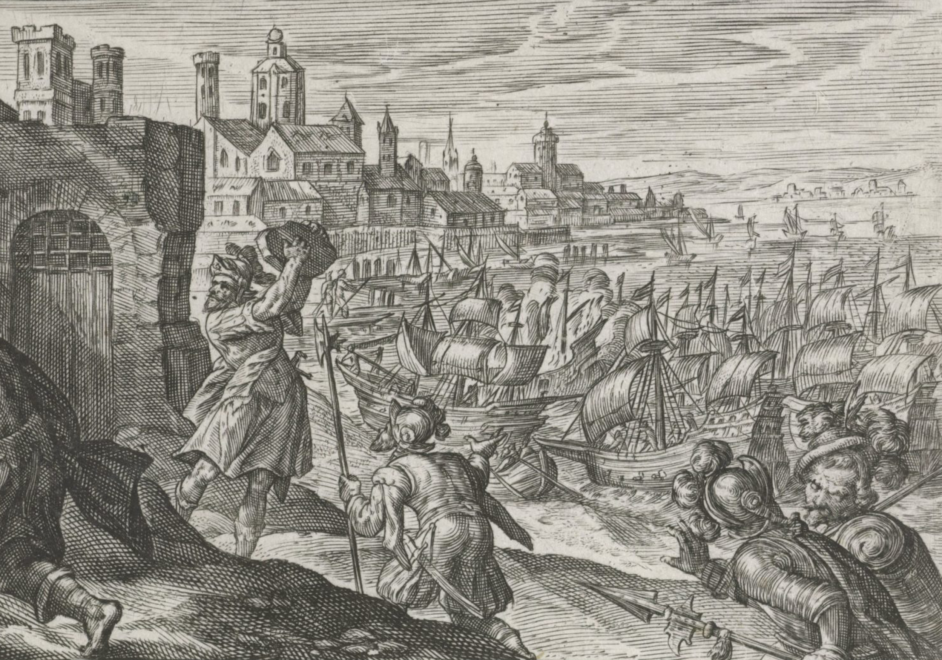
The Iliad utilizes the epideictic model of blame to portray Achilles as the most decisive force behind the and conquest of the Trojans, a tragic hero whose admirable power brings sorrow and destruction. Homer foreshadows Achilles’ role in the story for the reader in lines 1–2: “Rage—Goddess, sing the rage of Peleus’ son Achilles, murderous, doomed, that cost the Achaeans countless losses.”[1] The story proceeds to play out these lines in graphic and thrilling detail. The entire narrative arch of The Iliad hinges upon this question: Will Achilles fight the Trojans? Once this question resolves and Achilles joins the battle, victory over the Trojans is clearly secured. Thus, by following his character development and the devastating consequences which follow, one will come to know the wrath of Achilles through the poet’s eyes.
Achilles wins the admiration and sympathy of his readers through his godlike power and loyalty to Patroclus and his father. The narrative strews about descriptors of Achilles nearly every time his name is mentioned including “swift runner” (1.142), “the most violent man alive” (1.172), “blazing Achilles” (1.342), “strong as the gods” (9.587), “brilliant Achilles” (24.600), and most commonly “god-like Achilles” (1.154). Agamemnon attributes his value in war as being “worth an entire army” (9.140) and proceeds to offer him extravagant gifts. The narrative takes care to list out and repeat these gifts through the mouth of Agamemnon, his ambassadors, and Achilles as though to emphasize the incomparable power and worth of Achilles’ presence in battle. This portrayal bears out in the narrative as the mighty Hector flees at the sight of him and Achilles vanquishes him, turning the tide of the war single-handedly. His strength is featured as the driving force in the story which will determine the outcome of the entire plot.
Achilles also gains the reader’s sympathy by demonstrating great loyalty to both his father and to Patroclus, shown in their influence over his actions in the plot. It is only loyalty to Patroclus which can entice Achilles into battle and only loyalty to his father which could entice him to listen to Priam’s pleading that he be allowed to properly bury his son Hector. When honor and fame could not convince him to rejoin the battle, grief over a dear friend’s demise is the key. The characters whom he loves, pities, or honors are the primary external influences which can move Achilles to action, garnering the pity of the reader.
Yet the narrative suggests, by giving varied examples of his fickle character, that Achilles’ ultimate guide is internal passion rather than any judicious principle. Achilles changes from Agamemnon’s ally to his enemy when humiliated. He is said by Phoenix to have an “iron, ruthless heart” (9.602), unpersuaded by even his oldest friend. Achilles weeps for Briseis in Book 1 and but then declares, because of his wounded ego, that Agamemnon may as well “bed her now” (9.407) when offered the chance to recover her and to receive great treasure. He will not heed the advice of Phoenix, the old charioteer who serves as a kind of proxy father in the absence of Peleus, yet breaks under the passionate weeping of king Priam at the end of the novel and gives up Hector’s body for burial at last.
The turning point in the story stems from Achilles’ grief over Patroclus’ death, leaving him “overpowered in all his power” (18.28). This event marks the turning of the tide from Achilles’ withdrawal from the battle to his re-engagement and from the Achaeans’ uncertainty to their victory over Troy. What leads him both to withdraw from and to engage in battle is the same weakness: his passionate rage. He abandons Patroclus and Ajax because of the “proud spirit so wild in his chest” (Homer, 9.768), yet plunges into battle with ferocity and treats Hector’s body with cruelty once Patroclus is killed. He initially holds back from battle because of his mother’s prophecy that he will meet his “day of death” (9.499) in Troy yet throws himself into the battle regardless of the prophecy later on. The godlike Achilles wields great power over all those around him yet conflicting desires rule him, showing him to be a man unmoored from steadfast principles or self-mastery.
In addition to Achilles’ personal flaws, The Iliad invites the reader’s sympathy to lie heavily with the Trojans, emphasizing further their tragedy as inseparable from his victory. The poem both begins and ends with a lament for the Trojans creating a frame around the story of sorrow over tragedy and loss, rather than taking a victor’s perspective and portraying the war through the eyes of the victorious Achaeans. The narrative ends with Hector’s death, not even bothering to tell of the coming Achaean victory. Nearly all of Book 6 gives the reader a break from battle scenes in order to explore the domestic loyalties of Hector and Priam’s family. The reader glimpses a beautiful wife and happy child, a devoted mother and father, and an entire city hoping for rescue at the hands of Hector. When the great warrior finally falls slain, the reader’s heart drops as the poet returns to Andromache, weaving on her loom and preparing “his steaming hot bath” (22.521) with no knowledge of his demise. The final stanzas giving a glimpse of this devoted wife “cradling the head of Hector gently in her arms” (24.850–851). Glorious as the Achaean victory may be, the poem clearly laments this outcome and attributes all of its sorrows to the powerful involvement of Achilles. In conclusion, then, The Iliad holds up Achilles as an ultra-powerful warrior, capable of turning the tide of an entire war yet subject to his own passions and a bringer of sorrow and tragedy to beloved Troy.

[1] Homerus et al., The Iliad (Penguin Books, 1998), 1.1–2.